Why Choose a Sheet Extruder for Your Production Needs?
Choosing a Sheet Extruder is a production decision, not merely a machinery purchase. It affects thickness control, surface quality, energy use, and daily output. For manufacturers producing packaging sheets, construction panels, or technical films, the right system can reduce waste and stabilize demanding production schedules.
“Extrusion is a process, not a machine,” says extrusion specialist Chris Rauwendaal. This principle deserves attention. A reliable Sheet Extruder must work as part of a complete process, including material preparation, screw design, die performance, cooling, haul-off, and trimming. A well-designed line can deliver a sheet with consistent thickness across its width. Operators may notice the difference through fewer edge trims, smoother rolls, and fewer rejected batches.
The details matter. A precise temperature profile protects sensitive polymers from overheating. Stable melt pressure helps prevent visible waves and gauge variations. Efficient cooling can improve dimensional stability before the sheet reaches the cutting station. These benefits sound straightforward. They are not always easy to achieve.
Experience still matters.
An experienced supplier should explain output limits, compatible materials, maintenance intervals, and expected energy consumption. Independent testing, clear service records, and documented performance data strengthen that evaluation. However, no machine eliminates every production problem. Material moisture, recycled content, operator settings, and fluctuating demand can still affect results.
That is where careful questioning becomes valuable. A Sheet Extruder should match your real production conditions, not an idealized brochure. The best choice may not be the fastest line. It may be the system that delivers repeatable quality, manageable maintenance, and room for practical improvement.
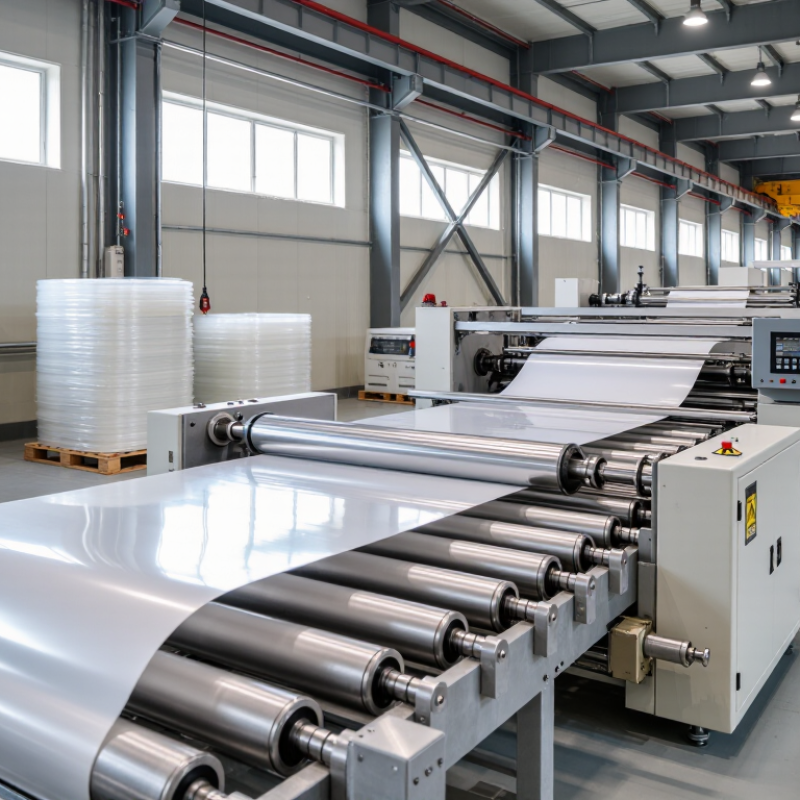
Sheet Extrusion Explained: Continuous Output at 0.2–25 mm Thickness
Why Choose a Sheet Extruder for Your Production Needs?
Sheet extrusion creates a continuous web of thermoplastic material, typically from 0.2 to 25 mm thick. That range covers thin protective layers, rigid panels, packaging sheets, and industrial components. A controlled melt pump, flat die, and calibrated rollers help maintain thickness across the sheet. Small temperature changes can still create visible variation.
The Plastics Europe Plastics—The Fast Facts 2024 report records global plastics production at 413.8 million tonnes in 2023. This scale reflects strong demand for efficient processing and repeatable output. A sheet extruder supports that demand by reducing batch interruptions and keeping production geometry consistent. It also allows operators to adjust width, cooling speed, and thickness during a running process.
Thin sheets need careful handling.
At 0.2 mm, cooling imbalance may cause curl, edge weakness, or uneven stress. At 25 mm, internal heat can remain trapped after the surface feels cool. Industry practice often combines infrared gauges, automatic die-bolt control, and regular laboratory checks. However, automation does not remove every risk. Material moisture, recycled-content variation, and imperfect calibration can still affect results. Production teams should verify actual thickness, not trust the machine display alone.
Compare Sheet and Film Lines: Sheet Thickness Typically Exceeds 0.2 mm
Why Choose a Sheet Extruder for Your Production Needs?
In plastics processing, sheet and film lines often differ by thickness. Sheet products typically exceed 0.2 mm, while film usually remains thinner and more flexible. This boundary is useful, but not absolute. Material type, width, and final application can change the equipment choice.
A sheet extruder offers stable melt delivery for thicker products. The process usually needs stronger cooling, precise die control, and reliable roll contact. During production, operators may inspect a 0.5 mm sheet under bright light. Small waves, edge thickening, or trapped air become visible immediately. These details affect cutting, forming, and surface quality.
From practical production experience, thickness control is rarely solved by the extruder alone. Feed consistency, screen condition, temperature balance, and haul-off speed all matter. A sheet line can support rigid panels, protective layers, and thermoforming stock. It also gives better handling when the material must hold its shape. However, thicker output can increase cooling time and energy use. That trade-off deserves careful testing. I have seen teams choose a powerful line, then overlook cooling capacity. The result was slower output than expected. Pilot trials, measured samples, and regular calibration make the decision more reliable.
Size the Line: Match 150–1,500 kg/h Output to Production Demand
A sheet extruder suits production teams that need steady, measurable output across different sheet sizes. The practical choice is not the largest line. It is the line that matches demand without creating idle capacity, unstable thickness, or excessive scrap. A 150 kg/h line can support pilot production, regional orders, and frequent material changes. A 1,500 kg/h system fits continuous operations, large contracts, and wider sheets with fewer interruptions.
Use verified demand, not optimistic forecasts. OECD’s Global Plastics Outlook reports that annual plastics production reached 460 million tonnes in 2019, doubling since 2000. Plastics Europe’s Plastics—The Fast Facts 2024 reports global production of 413.8 million tonnes in 2023. These figures confirm a large market, but they do not justify oversizing every extrusion line. Convert monthly demand into hourly demand, then allow for maintenance, start-up losses, and product changes. For example, 600 tonnes per year may require roughly 100 kg/h at 6,000 operating hours. That calculation can be wrong.
Check it against real production records. Resin moisture, cooling time, trim width, and operator skill can reduce effective output. A line rated at 1,000 kg/h may deliver less during frequent color changes. Record actual kilograms per hour for several weeks. Compare sellable sheet, not total melt throughput. Energy data also matters. The U.S. Department of Energy identifies process heating as a major industrial energy user, so oversized equipment can increase avoidable operating costs. Smaller may be wiser. But future contracts still deserve a realistic capacity margin.
Why Choose a Sheet Extruder for Your Production Needs? - Size the Line: Match 150–1,500 kg/h Output to Production Demand
The figures below are practical planning ranges for thermoplastic sheet extrusion. Actual output depends on resin type, melt temperature, sheet width and thickness, screw design, die configuration, cooling capacity, and product quality requirements.
| Line Size | Nominal Output | Recommended Planning Output
(80% Utilization) | Estimated Annual Output
(16 h/day, 300 days/year) | Typical Sheet Width | Typical Thickness Range | Suitable Production Demand |
| Compact | 150 kg/h | 120 kg/h | 576 tonnes/year | 600–1,200 mm | 0.3–6 mm | Pilot production, product development, specialty sheets, and regional demand |
| Small | 300 kg/h | 240 kg/h | 1,152 tonnes/year | 800–1,600 mm | 0.5–8 mm | Growing demand, standard packaging sheets, and multiple daily production shifts |
| Medium | 600 kg/h | 480 kg/h | 2,304 tonnes/year | 1,000–2,000 mm | 1–10 mm | Established converters, regular contract volumes, and broad product portfolios |
| Large | 900 kg/h | 720 kg/h | 3,456 tonnes/year | 1,200–2,500 mm | 1–12 mm | High-volume packaging, construction sheets, and continuous industrial supply |
| High-Capacity | 1,200 kg/h | 960 kg/h | 4,608 tonnes/year | 1,500–2,800 mm | 1–15 mm | Large-volume orders, centralized production, and demanding delivery schedules |
| Ultra-High-Capacity | 1,500 kg/h | 1,200 kg/h | 5,760 tonnes/year | 1,800–3,000 mm | 1.5–18 mm | Mass production, multi-market supply, and operations requiring substantial capacity headroom |
Capacity-sizing guidance: Select a line based on sustained production demand rather than peak demand alone. Maintaining approximately 70–85% of nominal capacity can provide room for start-up losses, material changes, maintenance, quality checks, and future volume growth.
Verify Quality: Apply ASTM D638 Tensile Testing and ±0.1 mm Gauge Control
A sheet extruder can support production when thickness consistency matters across every roll or cut panel. Its value becomes clearer when quality checks connect directly with processing data. A stable melt temperature, even cooling, and controlled haul-off speed help maintain a predictable sheet profile. However, equipment settings alone do not prove performance.
Gauge control within ±0.1 mm provides a practical starting point for dimensional reliability. Operators should measure points across the sheet width, including the edges and center. A calibrated micrometer can reveal small variations that visual inspection misses. Record readings by batch, time, and machine setting. This creates traceable evidence instead of relying on memory. The target is helpful, but it is not magic. Measurement uncertainty, temperature, and operator pressure can affect results.
ASTM D638 tensile testing adds a stronger performance check. Prepare correctly shaped specimens from different sheet directions when applicable. Test tensile strength, elongation, and modulus under controlled conditions. These results can show whether thickness control is supporting real mechanical performance. A sheet may meet the gauge target yet stretch unevenly or fail prematurely. That finding deserves investigation, not excuses. In practice, compare test results with extrusion temperature, cooling conditions, and sampling location. Keep rejected samples for review when possible. Small process changes can produce large differences. Quality work is often repetitive, and sometimes imperfect, but consistent records help engineers identify what truly needs improvement.