Skip To Content

How to Choose Steel Parking Bollards?

Choosing Steel Parking Bollards starts with understanding what they must protect. A row beside a storefront may need to guide cars and shield glass doors. A loading area may face heavier vehicle contact and frequent turning. The right choice depends on the site, not appearance alone.

“Choose the bollard for the impact risk and the way people use the space.” — [Insert a verified expert’s name and sourced quotation]

That principle is simple. The details are not. Compare steel grade, diameter, wall thickness, height, finish, and installation method. A thicker post is not automatically the better option if its footing, spacing, or exposure conditions are poorly matched. Check how the bollards will meet the pavement, where water may collect, and whether maintenance crews can reach them. Small details matter.

There is no universal specification. A design that works beside a level parking bay may be unsuitable near a sloped driveway or narrow pedestrian route. Measure vehicle paths. Note door swings, curb edges, drainage grates, and the distance between posts. Then confirm product data with the manufacturer and a qualified site professional.

Looks matter, too. So does visibility. Yet a polished finish cannot compensate for a weak installation plan. I would not assume a catalog image tells the whole story. Ask for drawings, installation guidance, and clear performance information before ordering. Good Steel Parking Bollards should suit the real site, including its awkward corners and everyday wear. That is where selection becomes practical.
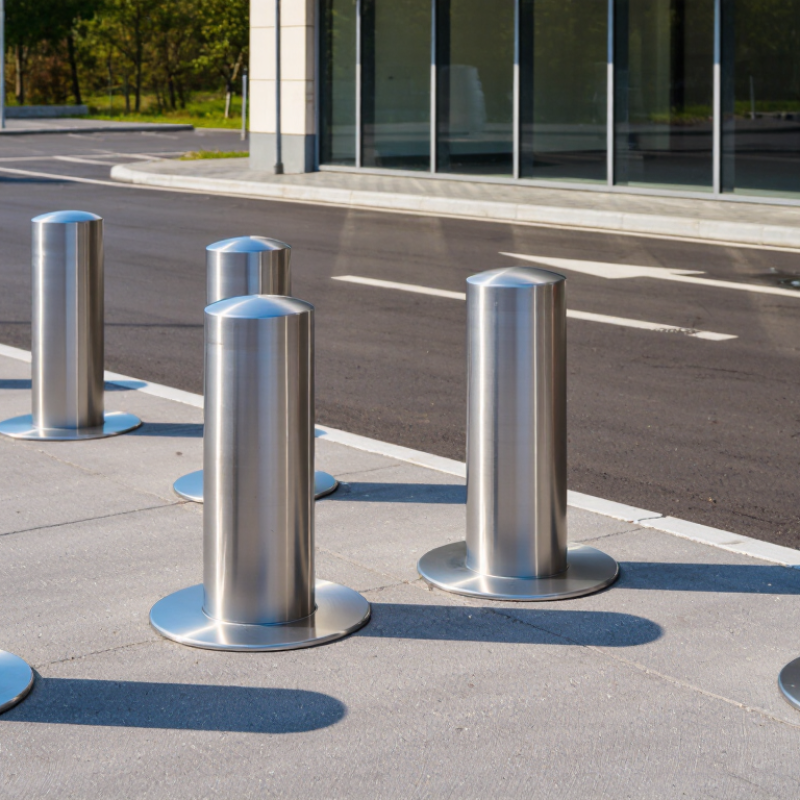
How to Choose Steel Parking Bollards?

Understand the Purpose and Types of Steel Parking Bollards

Steel parking bollards control vehicle movement, protect entrances, and create a visible buffer around walkways or loading areas. Their purpose determines the type.

Fixed steel bollards suit places needing constant protection, such as a storefront edge.
Removable models fit service lanes where occasional vehicle access is needed.
Retractable bollards can open and close without being carried away, but their mechanisms need maintenance.
Surface-mounted units can simplify retrofit work on existing concrete; however, their performance depends heavily on the slab and anchoring.

Protection levels vary. ASTM F3016 provides test methods for low-speed vehicle barrier systems, so buyers can compare tested performance rather than relying on appearance or pipe thickness alone. Check the tested vehicle conditions and installation details against the actual site.

NHTSA’s Traffic Safety Facts 2022 reported 42,514 U.S. traffic fatalities that year; this is not a parking-lot statistic, but it underscores why vehicle access and pedestrian separation deserve careful planning.

Placement matters. Measure turning paths, door swings, drainage, and clear walking space before setting bollards. A row that looks secure on a plan may obstruct a delivery truck in practice.

The right choice balances the threat, access needs, foundation, and daily use.

Assess Site Conditions and Vehicle-Impact Risks

How to Choose Steel Parking Bollards? Assess Site Conditions and Vehicle-Impact Risks

Start with the site, not the bollard catalog. Measure driveway width, turning space, curb height, pavement condition, and distance from doors or glass. A delivery van cutting a tight corner creates a different risk from a car approaching a storefront head-on. Note vehicle types, peak traffic times, and likely approach paths. Also check underground utilities before choosing foundations. A strong post in weak asphalt may still fail.

Match the protection level to credible impact risks. ASTM F3016/F3016M evaluates low-speed vehicle barriers at 10, 20, and 30 mph, offering a useful reference when comparing tested systems. These ratings do not guarantee identical performance in every installation; vehicle mass, impact angle, spacing, and foundation design matter. For higher-speed exposure, consult a qualified site or security engineer and review applicable crash-test documentation. Small details matter.

Tips: Photograph tire marks and turning movements during busy hours. Mark bollard centers on the pavement, then test vehicle clearance with a larger delivery vehicle. If the site has no impact history, treat that as uncertainty—not proof of low risk.

Compare Steel Grades, Dimensions, and Protection Ratings

Steel grade affects corrosion life, not impact strength by itself. ASTM A240 composition ranges put 304 stainless steel at 18–20% chromium and 8–10.5% nickel; 316 adds about 2–3% molybdenum, helping resist chlorides. That matters near coastal spray or winter road salt. For ordinary outdoor sites, coated carbon steel may be adequate, but damaged coating can expose the steel. Corrosion is not cosmetic.

Compare diameter, wall thickness, and embedment depth together. A wide bollard with a thin wall may not perform like a tested security barrier. Leave enough spacing for pedestrians and maintenance equipment, while keeping vehicle access controlled. Measure twice. ASTM F2656-20 impact ratings include M30, a test involving a 15,000-pound vehicle at 30 mph; the accompanying penetration rating records how far the vehicle travels beyond the barrier. Check the complete tested assembly, including foundation and installation details, rather than choosing by bollard size alone. Conditions on site rarely match a test yard exactly, and that gap deserves a second look.

Choose a Mounting Method and Visibility Features

Mounting choice should follow the pavement, impact risk, and maintenance plan—not just the bollard’s appearance. Embedded bollards need a drilled or formed footing, making them suitable where deeper foundations are practical. Surface-mounted models can be installed on sound concrete, but anchor spacing and slab thickness matter. If vehicles may strike the posts, ask an engineer to assess the foundation and expected loads; a strong steel tube cannot compensate for weak concrete.

Visibility needs to work at a driver’s approach angle and in poor light. Consider reflective bands, contrasting colors, and lighting where the site assessment supports it. The NHTSA report Traffic Safety Facts: Pedestrians, 2022 recorded 7,522 pedestrian deaths in the United States. That figure does not prove bollards prevent crashes, but it underscores why clear visual cues matter around vehicle and pedestrian paths. Check whether reflections remain visible when headlights are low or the surface is wet.

Removable bollards suit access points that need occasional opening, though their sockets can collect grit and water. Fixed posts may be simpler, but they can obstruct deliveries or maintenance. A small mock-up helps: view it from a driver’s seat, then check it at dusk. It’s easy to overlook. The first layout may still be wrong. Keep the final spacing consistent, and confirm that visibility features do not conceal damage or interfere with nearby signs.

How to Choose Steel Parking Bollards? — Choose a Mounting Method and Visibility Features

Compare mounting options against your site needs: embedded bollards are typically the most permanent, while socket-mounted and surface-mounted options can be easier to replace or relocate. Ratings are qualitative planning scores, not measured test results. Choose high-visibility finishes or reflective bands where drivers need to see bollards clearly, and confirm installation requirements with a qualified installer.

Check Installation, Accessibility, and Maintenance Requirements

Before choosing steel parking bollards, map vehicle paths, door swings, drainage, and underground utilities. A concrete base may need deeper anchoring where vehicles can strike the posts. Confirm the footing and anchor design with a qualified installer; soil, slab thickness, and expected impact conditions matter.

NHTSA’s 2022 Traffic Safety Facts recorded 7,522 pedestrian deaths in U.S. traffic crashes. That figure supports careful separation of vehicle and pedestrian routes, but bollards alone cannot guarantee safety.

Accessibility needs equal attention. The U.S. Access Board’s 2010 ADA Standards specify a 36-inch minimum clear width for accessible routes; bollard placement must not narrow that passage. Measure between posts and check turning areas near ramps, entrances, and payment machines.

A drawing can look spacious, yet feel tight beside a wheelchair or stroller. Small details matter. Choose finishes and spacing that allow routine cleaning and inspection. Look for loose anchors, corrosion at the base, chipped coatings, and standing water. Replace damaged parts before they become a hazard.

Tips: Mark proposed post locations with tape, then walk the route with a cart or mobility aid. Keep a simple inspection log. Check after impacts, winter treatment, and maintenance work. If access feels awkward, revise the layout before installation.